
What we learned from our community call about cooperative finance, shared digital infrastructure and the emerging collaboration between Platform Coops eG and the Democratic Tech Fund.
On 4 November 2026, we invited our community to explore a proposition that is becoming increasingly urgent: if technology is to serve people and communities, democratising the code will not be enough. We also need to democratise the economic structures through which technology is financed, owned, governed and sustained.
The 90-minute call brought together social entrepreneurs, cooperative founders, tech pioneers, platform operators and people developing new financial and digital infrastructure. Several initiatives that Platform Coops eG currently accompanies through its advisory work also joined the discussion. This made the session more than a presentation of concepts: it became an exchange between people already testing cooperative ownership, community finance and democratic technology in practice.
You can watch the full recording of the community call here.
Fittingly, the call itself did not take place on one of the dominant commercial conferencing platforms. We met through a decentralised, self-hosted BigBlueButton infrastructure provided by meet.coop — a small but tangible example of choosing digital tools that are more closely aligned with the values under discussion.
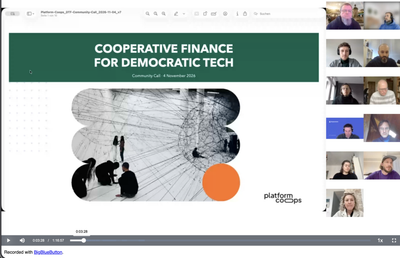
The Community Call and Andreas Arnold’s opening presentation, hosted on meet.coop’s BigBlueButton infrastructure.
Why democratic technology needs a cooperative economy
Ela Kagel hosted and critically framed the session. Drawing on two decades of observing the development of the creative and technology sectors as a digital strategist, she opened a space not only for presenting projects, but also for questioning the conditions under which technology is currently created and delivered. Who benefits from a digital service? Who carries its costs? And at what point are users themselves turned into data products?
These questions connect directly to the analysis of the Democratic Tech Fund: digital infrastructure has become concentrated in the hands of a small number of corporations, giving private owners control over essential layers of public and economic life. Open-source, federated and community-owned alternatives already exist. What they often lack is consistent investment, organisational capacity and an ecosystem capable of bringing them into sustained use.
Andreas Arnold began his presentation by placing democratic technology and the cooperative social economy side by side. Democratic technology is associated with user-centred development, open source, the ability to self-host, data protection and technological sovereignty.
The cooperative economy contributes democratic ownership, social and environmental purpose, member participation and governance based on cooperative principles.
The relationship works in both directions. Technology can only fulfil a democratic purpose when it is governed by the people it is supposed to serve. At the same time, cooperatives and social enterprises depend on digital tools that do not undermine their values through extractive business models.
The Inference Cooperative provided one current example: members jointly finance and govern access to privacy-preserving AI infrastructure on users’ terms. It illustrates how ownership, technology and financing can be designed together instead of being treated as separate questions.
A good idea is not yet a sustainable project
The central problem, however, is rarely a lack of good ideas. Through our advisory work with social innovations, commons-oriented initiatives and cooperative founders, we repeatedly see capable teams with relevant solutions struggle because they lack the money, visibility and organisational capacity required to reach a critical mass of users.
Andreas therefore introduced a broader cooperative-finance toolbox. Alongside revenue from products and services, cooperatives can mobilise membership shares and member loans. Communities can use peer-to-peer lending, microcredits, rotating or accumulating savings associations, and financing relationships between cooperatives. Cooperative and community banks can add further layers. These mechanisms do not remove the need for sound business models, but they widen the range of people who can finance and govern a shared undertaking.
This is particularly important as public grants and subsidies become more difficult to secure. Projects need financing models that do not end when one funding programme closes. They also need supportive ecosystems in which money, knowledge, demand and technical capacity reinforce one another.
That is the background to Makowi - the marketplace for the cooperative economy. Makowi is intended to make the products, services and capacities of cooperative and social-economy actors visible to one another. A shared marketplace can help organisations purchase more of what they need from within their own ecosystem. A cooperative complementary currency could later allow value to circulate through this network for longer and create additional financial capacity for shared projects.
Makowi is therefore not just a marketplace or a financial tool. It is an ecosystem-level approach: an attempt to make existing resources discoverable and strengthen the network effects between cooperative actors.
From a fund to a community-led infrastructure
Wouter Tebbens then introduced the Democratic Tech Fund and the thinking behind its emerging crowdfunding ecosystem. DTF is not conceived as a conventional fund that begins with a large pool of capital and distributes it from the top down. It is being built as a member-based community in which people and organisations contribute money, time, knowledge and infrastructure. Join as member. Check out the call for projects and the platform.
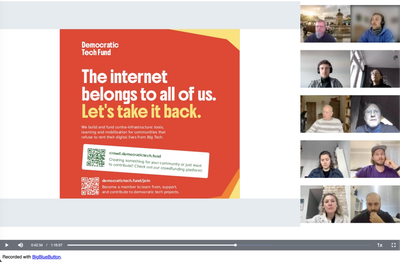
Wouter Tebbens introduces the Democratic Tech Fund and its community-led approach to financing digital infrastructure that communities can own and govern.
The model connects several layers. Communities identify needs and discover existing tools. Funding circles can help validate and strengthen projects. Crowdfunding mobilises a wider public and builds a constituency around the infrastructure being proposed. In the future, institutional match funding could multiply the resources contributed by the crowd. The DTF model combines technology, shared learning, funding and federation — because digital autonomy depends on all four.
This makes crowdfunding more than a transaction. A campaign can test whether a need is genuinely shared, attract future users and contributors, and create accountability between a project and its community. At the same time, the discussion acknowledged that crowdfunding is only one component of sustainability. Projects also require governance, viable business models, technical maintenance and people who can do essential work without depending entirely on unpaid labour.
The community already holds many of the required resources
The discussion that followed made the potential of this approach especially visible. Participants brought experience from social entrepreneurship, cooperative platform development, grant and funding infrastructure, community-controlled AI, decentralised hosting, care services, open-source tools, local payment networks, research and civic technology.
Some had already financed cooperatives by bringing future members into the process. Others were building tools that make public funding easier to access, experimenting with collectively owned infrastructure or developing ways to transfer cooperative models between places. The conversation also surfaced important cautions: a cooperative legal form is not automatically suitable for every project, crypto-based mechanisms can create cultural and practical barriers, and financing models must fit both their communities and their legal contexts.
One conclusion stood out: many actors can support the DTF ecosystem without primarily contributing money. They can offer software, hosting, legal or governance knowledge, campaign support, research, facilitation, business development, communication or access to other networks. These contributions may be just as important as financial capital during the early development of a project.
But for that to work, the offers must be visible. People need to know who can contribute what, which capacities already exist and where demand is emerging. This is also a clear call for Makowi. By mapping actors, services and needs, the marketplace could help DTF members find and use one another’s resources. These connections create network effects: every useful contribution makes the ecosystem more valuable to the next participant. More knowledge, service capacity and potentially financial capital can remain within the network instead of continually flowing out to external providers.
Learning from MokumPay in Amsterdam
During the call, we also learned about an initiative in Amsterdam that has striking parallels with parts of the Makowi vision. MokumPay is developing a local payment network in Amsterdam Nieuw-West. It helps residents, organisations, institutional buyers and local businesses find one another and encourages income earned within the network to be spent again with other participating members.
Visibility is a crucial part of its design: participating businesses and their offers are listed so that residents, other enterprises and purchasing organisations can find them. MokumPay also uses a circulation contribution on income that has not yet been spent again within the network. This creates an incentive to recirculate value while helping finance the network and local initiatives.
Makowi and MokumPay are developing in different contexts and should not be treated as identical models. Yet they share a central ambition: making economic relationships visible and keeping value circulating within a defined community for longer. We will reconnect with the team in Amsterdam to explore what we can learn from their approach, including their incentive design, local adoption strategy and cooperative governance.
Platform Coops eG is becoming a steward in the DTF ecosystem
The call also marked an important next step in the cooperation between Platform Coops eG and the Democratic Tech Fund.
As a partner and steward in the DTF ecosystem, Platform Coops eG will support democratic-tech projects from Germany and EU-wide initiatives with free guidance on cooperative business models, governance structures, fundraising, financing opportunities and the founding process.
Our contribution begins before a crowdfunding campaign goes live. Together with project teams, we can examine the problem they want to solve, validate the role of the intended community, develop meaningful membership benefits and determine whether cooperative ownership is the right model. We can then help projects prepare their governance and financing approach and strengthen the foundations on which a credible campaign can be built.
As part of our contribution to shaping the DTF platform, we are also considering running a crowdfunding campaign for Makowi through DTF. The community call made clear that the ecosystem needs a way to identify its actors, make their offers discoverable and connect available capacities with concrete project needs. Applying Makowi within the DTF community could therefore serve two purposes at once: it could advance an infrastructure project for the cooperative economy and offer a practical resource-mapping layer for the DTF ecosystem itself.
This conversation should continue
By the end of the session, participants were already asking for another call in the series. That response suggests the topic resonates because it connects challenges that are too often discussed separately: technological sovereignty, cooperative ownership, financing, ecosystem development and the everyday work of sustaining shared infrastructure.
Democratic technology will not emerge from code alone. It needs communities capable of deciding what should be built, organisations that can maintain it, and financial structures that allow people to contribute without surrendering control to extractive investors or platforms.
The encouraging lesson from this first call is that many of the required resources already exist. The next task is to make them visible, connect them and organise them cooperatively.