
1. Design
We make visible who belongs to the ecosystem, which problems and resources exist, and which interactions can create mutual benefit.

Cooperative Finance
We help organisations, cooperatives and networks turn shared challenges into working cooperation, platform and business models. To do this we combine ecosystem mapping, platform design, governance, business modelling and prototyping into one continuous development process.
Starting point
In many sectors the necessary actors, offers, resources and technologies already exist.
And yet no viable cooperation emerges:
We create a structured framework to develop a capable ecosystem out of this fragmented landscape of actors.
Our approach
We make visible who belongs to the ecosystem, which problems and resources exist, and which interactions can create mutual benefit.
We develop and compare business, governance, financing and participation models. This clarifies who contributes what, who decides, and how the ecosystem sustains itself in the long term.
We translate the prioritised model into simulations, prototypes and a limited pilot with real actors – before major development or investment decisions are made.
Cooperation doesn’t arise from technology, but from clarity about who contributes what and who benefits.
Offer
We identify relevant stakeholders, cluster their roles and examine problems, resources, relationships and dependencies in the existing system. We ask:
Result: An ecosystem map with prioritised opportunity areas, anchor actors and initial interaction hypotheses.
We design the interactions that a cooperative ecosystem should enable. Together we develop:
Result: A prioritised interaction and platform model.
Cooperation needs not only transactions but comprehensible rules. We clarify:
Result: A governance model with roles, decision rights and possible operating structures.
We develop several economic options separately and compare them systematically. We consider both the ecosystem as a whole and the business model of a potential operating organisation:
Result: Assessed business-model variants with a comprehensible sequence for piloting and scaling.
Not every ecosystem needs its own currency. But every ecosystem needs a clear logic for money, contributions, risks and economic participation. We examine and design:
Result: A comprehensible payment, financing and incentive model, including risks and regulatory requirements.
We make abstract models tangible. Depending on the question, we develop:
Result: A testable concept prototype and qualitative feedback from the future participants.
A technical MVP alone isn't enough if providers, users and operators haven't yet found a working interplay. So we build the smallest possible but genuinely working slice of the planned ecosystem. At its centre are one anchor organisation, a clearly defined user group and a few selected providers. Together they form a manageable system in which one to three concrete interactions take place and can be tested through a simple fulfilment process. The pilot is complemented by measurable success criteria and a realistic operating model.
The result is a low-risk pilot that shows not only whether the application works technically, but above all whether the interplay of the actors involved holds up in practice.
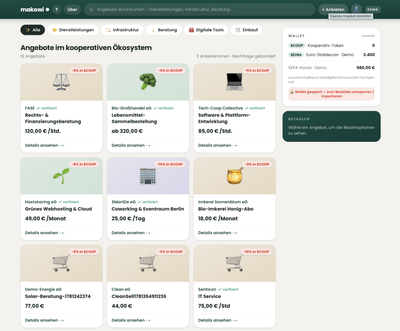
With MAKOWI we designed a digital marketplace for the cooperative and public-benefit economy. The starting point was the core challenges of social and cooperative organisations: low visibility, fragmented demand, missing liquidity and dependence on grants – as well as money flowing out to external platforms and providers. We examined the relevant actors and their roles, developed possible interactions and made the model tangible in talks, workshops and a stablecoin game.
This produced a holistic marketplace model with a wallet and payment process, a complementary-currency logic and a liquidity and impact dashboard. It was complemented by several revenue models and a financing and investment model. The key insight: technical implementation is rarely the first hurdle. What matters is an urgent shared problem, a financeable anchor, viable incentives and the social coordination of the ecosystem. MAKOWI is thus a reference for how we design cooperative platform models, model them economically and surface their central assumptions early.
What began with the cooperative economy can work wherever actors achieve more together.
Fields of application
Housing cooperatives can connect members, local providers and shared infrastructure. We show how.
Energy producers, consumers, municipal utilities, housing companies and citizen energy cooperatives can develop local energy and investment models.
Members, customers, financial institutions and regional businesses can develop new forms of shared financing and economic participation.
The insured, insurers, prevention providers and local networks can move from pure claims settlement to shared prevention ecosystems.
Vehicle manufacturers, fleet operators, municipalities, housing companies and users can organise mobility as a shared ecosystem.
Producers, processors, retail, restaurants, canteens and consumers can better coordinate demand, logistics and financing.
Self-employed people can organise beyond classic intermediation platforms and build shared infrastructure.
Social enterprises, cooperatives and public-benefit organisations can connect supply, demand and financing in a shared economic space.
In a first conversation we look at your starting point, possible anchor actors and the question of which next step makes sense.