
Several smartphones lay side by side on a green checked table. A test order had entered the system, and everyone leaned in to see which phone would receive the first notification. The exercise looked simple. It also exposed the rules that large delivery platforms usually keep out of sight. The nearest available rider should receive the offer. If several riders were at a similar distance, the one who had waited longest should come first. The rider could still decide whether to accept the job.
This took place on 24 October 2026 in Lamphun, south of Chiang Mai. I had joined Akkanut Wantanasombut, Head of the Research Group in Innovation for Social Solidarity and Inclusive Economy in Asia at Chulalongkorn University's Institute of Asian Studies, and a group of his students. Our host was connected to the Maetha Organic Group, one of several local communities that have approached Tamsang-Tamsong because they see a use for the model in their own area.
The day changed my understanding of what it means to establish a local platform. A technical system had been developed, but nobody treated installation as the main task. Riders, restaurant owners, the local host and the university team were learning how a transaction would work, who would carry which risk, and how they would respond when something did not go according to plan. People who lived in the same area were being introduced as future economic partners. Trust was part of the infrastructure.
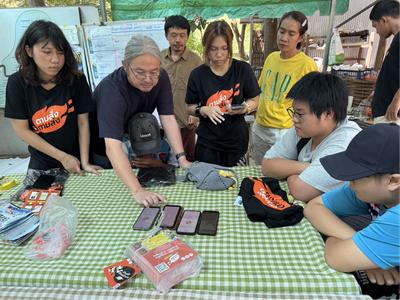
Testing the dispatch logic together at the host location in Lamphun. Participants watch which rider receives the simulated order based on distance and waiting time. Photo by the author.
The conference context and Solidarity AI
I came to Thailand for the international Platform Cooperativism conference on Solidarity AI at Chulalongkorn University from 12 to 15 November 2026. In the conference reading, Trebor Scholz describes Solidarity AI as a project of democratic control across the layers of technology, from land and data centres to models, data and labour. His argument draws on Buddhist interdependence, Thailand's sufficiency economy, Gandhian decentralisation, and feminist and decolonial critique.
The same argument applies beyond AI. A platform that coordinates meals, deliveries or rides also distributes decision-making power. It determines whose costs remain invisible, who may set the rules, and who captures the value created by the network. A democratic alternative therefore cannot be judged by ownership of source code alone. Its institutional design and everyday relationships matter just as much.
Tamsang-Tamsong provided a concrete example. The team used current technology, including AI-assisted programming for selected parts of the development process, without treating technical scale as an end in itself. It built only the layers the community still needed, relied on existing infrastructure where appropriate, and involved affected people in defining the operating rules. This was a practical expression of technological sufficiency.
The meaning and scope of Tamsang-Tamsong
The Thai name explains the original service. Tam or dtaam means to follow, to act according to, or to conform to something. Sang means to order or instruct. Tam sang therefore means made according to an order. Ahan tam sang is the familiar Thai category of food cooked to order. Song means to send, deliver, drop off or accompany someone to a destination. Tamsang-Tamsong combines food made to order with people or goods being delivered.
The project's own description presents it as a community channel for ordering food and transporting people. It originated during the Covid-19 crisis, when restrictions hurt small food vendors and motorcycle taxi drivers while mainstream delivery platforms charged restaurants substantial commissions. The research team connected local vendors, riders and customers through a solidarity economy model.
The model has since moved beyond one neighbourhood. Different communities can host their own local service. Each host responds to its context, while Tamsang-Tamsong supplies the tools, knowledge and support needed to start. The term platform can therefore be misleading if it suggests one centrally managed marketplace. What I saw was closer to a shared method and technical commons that can be adapted by multiple local ecosystems.
Research funding and paid participation
Tamsang-Tamsong grew out of an action-research environment rather than a conventional startup accelerator. Akkanut described a setting in which social initiatives can be researched, tested and put into practice with public and university-linked support. Chulalongkorn University and the Thai Health Promotion Foundation have publicly presented the platform as a research-based solidarity economy initiative. Institutional funding created room to develop a tool before extracting revenue from its users.
The financial culture around the work also differed from the venture-capital model familiar in Europe. Akkanut explained that grants, loans and support from alumni networks can help initiatives move forward. Successful projects may later return resources so that further experiments can begin. I understood this less as an investment seeking an exit and more as a circulating pool of support. These arrangements differ by project; this is the support model as it was explained to me during the visit.
The students on the trip were not being asked to provide free labour for a semester exercise. I was told that they were paid for their contribution, at rates clearly above the statutory minimum. That detail mattered. A social business should not hide unpaid work behind its mission. Here, cost discipline was combined with a willingness to pay people fairly, including those still in education.
Technological sufficiency
European social enterprises often inherit a large technical and administrative overhead. A new platform may commission a complete product, add its own payment system, map, identity layer and reporting functions, and then face the recurring cost of maintaining each component. Good intentions do not protect such a project from becoming financially heavy.
The team in Thailand chose a narrower technical scope and used AI-assisted programming for selected parts of the development process. AI complemented rather than replaced the team’s broader development work. The team focused its own efforts on the service components that were still missing instead of trying to control every transaction layer. This reduced development costs while allowing existing providers to remain useful participants in the ecosystem rather than turning them into competitors the platform sought to replace.
The same principle shapes how people access the platform. Tamsang-Tamsong is available through dedicated mobile applications as well as through LINE, the messaging platform many people in Thailand already use every day. Offering a familiar channel lowers the digital literacy barrier, particularly for older people and others who may be less comfortable learning a new application. Instead of requiring every participant to adapt to an entirely new interface, the platform meets many of them in a digital environment they already understand.
Payments provide another example. Riders and restaurants can use Thai QR Payment through PromptPay, the interoperable payment infrastructure supported by the Bank of Thailand. PromptPay links identifiers such as a phone number or citizen ID to an existing bank account. Users pay through their mobile-banking applications, often without a transaction fee. Tamsang-Tamsong therefore does not need to operate a proprietary wallet or give a payment processor another claim on each order.
This approach resembles the principle of sufficiency discussed around the conference. The platform uses what the task requires and leaves the rest to complementary infrastructure. Frugality here is not a reduced version of an integrated commercial platform. It is a design decision about where the platform should end.
Local hosts and community stewardship
Maetha was one of several hosts that have contacted the Tamsang-Tamsong team. The distinction matters. The project does not arrive in a new locality with a marketing budget and a demand to acquire users. Interested communities approach the research team because they recognise a local problem and believe the model may help solve it. This creates a pull dynamic rather than a sales campaign.
A host is more than a point of contact. It convenes the people whose cooperation the service needs. In Lamphun, the host organised a meeting with prospective riders and another with restaurant owners. It provided local legitimacy, knowledge and relationships. In the future it may also speak with local government, explore procurement opportunities and identify institutions whose staff already order meals during the working day.
I would describe this role as ecosystem stewardship. The host watches the whole local arrangement rather than representing only riders, restaurants or customers. It can see where a relationship is missing and bring the relevant people together. It also gives the community a local centre of responsibility after the university team leaves.
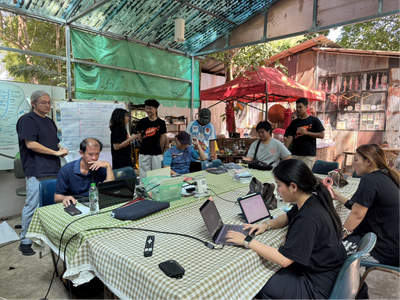
Platform development as fieldwork. The Tamsang-Tamsong team and local participants configure the service together at the host location. Photo by the author.
Onboarding through practice
The onboarding began with a discussion of platform economics. The team compared extractive delivery companies with community-owned alternatives and explained how commission structures affect working conditions, restaurant margins and customer prices. The presentation established a shared reason for doing the work before anyone entered data into an app.
The prospective riders then registered and discussed the delivery price. They worked towards a consensus on a fair rate per kilometre. It had to cover fuel and labour without making the service too expensive for local customers. Supply, demand and affordability were present in the conversation, but the platform did not impose a price from a distant headquarters.
Later, restaurant owners gathered at another central location in Lamphun. The team entered their locations and other service data into the system. The restaurants could ask questions and register immediately. The group then simulated an order from beginning to end. Different rider locations produced different notifications; a rider accepted the job, collected the meal, paid the restaurant and completed the delivery.
The simulation did two things at once. It taught participants how to operate the software and introduced them to one another as business partners. Some lived in the same town without having met. The workshop made their future interdependence tangible. A restaurant had to trust that a rider would collect a prepared meal. A rider had to trust that the customer would repay the advance. The customer had to trust the quality and timing of both parties.
The work did not remain at the workshop stage. On 15 November 2026, the local instance hosted by Maetha began operating with 50 participating restaurants and 19 riders. Just over three weeks after the field trip, the relationships and processes rehearsed during the workshop had become part of an operating local delivery network.
The order and payment process
The order flow I observed was deliberately light. When a customer placed an order, the system identified an appropriate rider by location and waiting time. The rider received an offer and remained free to decline it. There was no hourly quota or acceptance-rate pressure of the kind associated with large delivery platforms.
At collection, the rider paid the restaurant, usually by scanning its QR code. The rider therefore advanced the cost of the food. The customer paid after receiving the order, reimbursing the meal and paying the locally agreed delivery charge. Because the platform did not intermediate the payment, the money moved directly between participants.
The simplicity carries real risk. Riders in this context do not necessarily have the employment protections that European readers may assume. The young participants described a world in which a driving licence was the essential formal requirement and individuals had to arrange much of their own protection through insurance, family and social networks. The platform offers autonomy, but it does not remove the wider gaps in social security. Any transfer of this model to Germany would have to preserve its democratic qualities while meeting a very different legal and welfare framework.
The co-contribution model
Tamsang-Tamsong uses what the university describes as a co-contribution model. In the version explained during the field trip, the local host does not pay a compulsory licence fee to the central project. Restaurants and riders do not owe a fixed commission to the host or platform, and customers do not pay a mandatory platform surcharge. The food and the delivery still have clear prices. The additional contributions that sustain the shared infrastructure are voluntary.
The model calculation shown during the workshop allowed each group to contribute from the value it received. A restaurant could share part of its margin with the host. A rider could contribute from delivery income. A customer could add support when paying for the service. The local host could in turn return part of its resources to the team maintaining the shared platform.
This differs from a commission added as another layer of rent. Participants first earn income or receive a useful service, and then decide whether to support the infrastructure that enabled it. The arrangement assumes a culture of reciprocity and visible benefit. It may also reveal a higher willingness to pay than a fixed fee would capture. Its long-term resilience will depend on whether local hosts can make the contribution flows understandable and keep operating costs transparent.
ThaiEconoMap and shared digital infrastructure
Restaurants joining the delivery service can also become visible on ThaiEconoMap, a digital map informed by the Social and Solidarity Economy and digital-commons thinking. Akkanut has described the map as a shared space in which people can participate as producers, consumers and co-designers of development. The map makes local economic actors easier to find beyond a single delivery transaction.
This is another example of a modular ecosystem. Tamsang-Tamsong does not need to reproduce the full discovery and mapping function inside its own interface. ThaiEconoMap gains useful entries, while restaurants gain visibility. Each service remains distinct, and the relationship between them creates additional value.
Comparisons with Khora and CoopCycle
Khora and SMart in Berlin
The Lamphun visit reminded me of an earlier attempt to build a fair delivery alternative in Berlin. Foodora was absorbed into Lieferando, and Deliveroo left Germany in August 2019 with very little notice. Many experienced riders suddenly faced unemployment. Platform Coops Germany supported a group that tried to organise its own service under the name Khora.
The group consisted of committed bicycle couriers, but a delivery company needs more than riding expertise. Khora therefore operated with SMart eG as its organisational and fiscal home rather than creating a new legal entity from scratch. It used CoopCycle for dispatch and ordering. At one point the collective involved around 30 people and operated for roughly two years. Eurofound now lists the initiative as inactive.
Khora already followed an ecosystem logic. It relied on allied organisations for legal structure and technology. Its weakness was not a lack of commitment or a failure to build everything itself. The group could not finance the marketing needed to compete with venture-backed platforms. It also began from the urgent need of one stakeholder group. Restaurants were commercial partners, but they were not convened as equal co-designers of the whole local system.
CoopCycle as a federation
CoopCycle is the closest European comparison, but it should not be reduced to software. The CoopCycle federationprovides a logistics and e-commerce platform, hosting, training, technical support, business-development assistance, grant support and a network for mutual learning. Its Coopyleft licence reserves commercial use for cooperatives, associations and limited-profit organisations. Member organisations govern the federation on a one-member-one-vote basis.
The current contribution model is also more formal than Tamsang-Tamsong's. CoopCycle states that members pay EUR 49 per month during their first year and then two per cent of delivery revenue generated through the platform. Its software offers a comparatively complete stack, including order management, dispatching, route planning, invoicing, storefronts and payment integration.
The difference is therefore one of centre of gravity. CoopCycle is a rider-led federation that helps delivery organisations become viable and democratic. Tamsang-Tamsong starts with a local multi-stakeholder ecosystem and a host responsible for convening it. Its field team brings riders and restaurants into the same practical process and uses complementary public or commons-based infrastructure instead of integrating every function.
Lessons for us
The field trip has direct implications for Platform Coops eG and Makowi, the marketplace for the cooperative economy. An ecosystem business model creates more than the sum of its individual products. It should also decide deliberately which organisation performs each function and where money can remain in cooperative circulation.
Our three-stage approach begins with shared service providers, connects their products and services, and may later add a cooperative complementary digital currency. Tamsang-Tamsong adds an important discipline to this thinking: an ecosystem should give work to capable partners wherever possible. Building another internal service may weaken the very network we want to strengthen.
The relevant stakeholder categories for Makowi will not be restaurants and motorcycle riders. They will include providers, service contributors, co-contributors, users and enabling partners. The transferable principle is to recognise these actors as interdependent participants with a legitimate voice in the system. The platform organisation should fill gaps, connect contributions and make cooperation easier without absorbing every role itself.
The Thai experience also changes the sequence of platform development. European projects often build a product, search for users and then add community management. Lamphun began with a host that could convene the community. The team explained the economic model, let the participants negotiate important terms and tested a real transaction together. Software entered an existing field of relationships instead of trying to manufacture a market after launch.
AI-assisted development belongs in this lesson, but only as one element. Lower programming costs can free resources for facilitation, fair pay and local support. Efficiency becomes socially useful when the savings strengthen the people and relationships around the technology rather than simply increasing a platform owner's margin.
Community ownership begins before launch
At the end of the workshop, restaurant owners, delivery riders, the Tamsang-Tamsong team and the field-trip participants gathered for a photograph. The riders had received their own introduction earlier in the day, but the central workshop brought them together with the restaurant owners. They met as future business partners and jointly tested how their local platform would work.
The group simulated a complete order involving every stakeholder. An order entered the system, the dispatch logic selected a rider, the rider accepted the request, collected and paid for the food at the restaurant, and completed the delivery. This made the platform’s interdependencies tangible. Everyone could see how their own role connected to the decisions, payments and responsibilities of the others. Trust was built through direct interaction rather than left to the software.
This is the main lesson I am taking back to Berlin. Community ownership does not begin when shares are issued or source code is published. It begins when the people affected by a platform understand its rules, meet one another, negotiate their contributions and gain the practical capacity to operate it together.
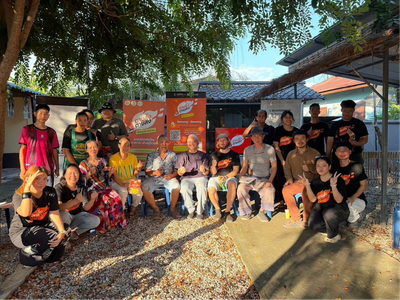
Restaurant owners, delivery riders, the Tamsang-Tamsong team and field-trip participants after jointly testing a complete order flow in Lamphun on 24 October 2026. Photo provided by the field-trip group.
Sources and further reading
- Trebor Scholz Solidarity AI
- Tamsang Tamsong About the platform
- Chulalongkorn University Community ownership and the solidarity economy model
- Chulalongkorn University Local project supporting drivers and vendors
- Bank of Thailand PromptPay and Thai QR Payment
- ThaiEconoMap Restaurant map
- Towards Organic Asia Visiting Maetha Organic Group
- CoopCycle Federation services governance and contribution model
- CoopCycle Coopyleft licence
- Eurofound Courier Collective Khora
- The Guardian Food delivery cooperatives and Khora
Author: Andreas Arnold